
Top 10 Premier League Summer Transfers 2026: Ultimate Ranking Reveals Who Ranks No.1
You’ve seen the headlines boasting huge signings during the Premier League summer transfer window, but transfer fees alone don’t tell the whole story. In this guide, we rank the 10 biggest confirmed Premier League summer arrivals of 2026 by player quality, tactical fit, club need, value and early-season performance. We go beyond the numbers to determine which new signings really stand out and could define the season.
Key points
- Transfer window timeline: The 2026 Premier League summer transfer window opened on 15 June and closed on 1 September 2026.
- Ranking criteria: The strongest transfer ranking should consider more than fee alone—factors include player quality, tactical fit, squad need, value and measurable impact.
- Mega transfers: Four players reportedly moved to Premier League clubs for fees of £100 million or more during the 2026 summer window.
- Early impact vs long term: Early-season performances can indicate a signing’s immediate impact, but should be separated from longer-term expectations.
- Tactical role matters: A player’s tactical role (e.g. playmaker, enforcer, wide threat) can be as important as individual stats when assessing a new signing’s value.
- Official transfer records: The Premier League’s official Transfer Watch page lists all confirmed 2026 summer deals for reference.
- Ongoing evaluation: Rankings should be updated as the season develops and new performance evidence emerges.
What Are the Top Premier League Summer Transfers of 2026?
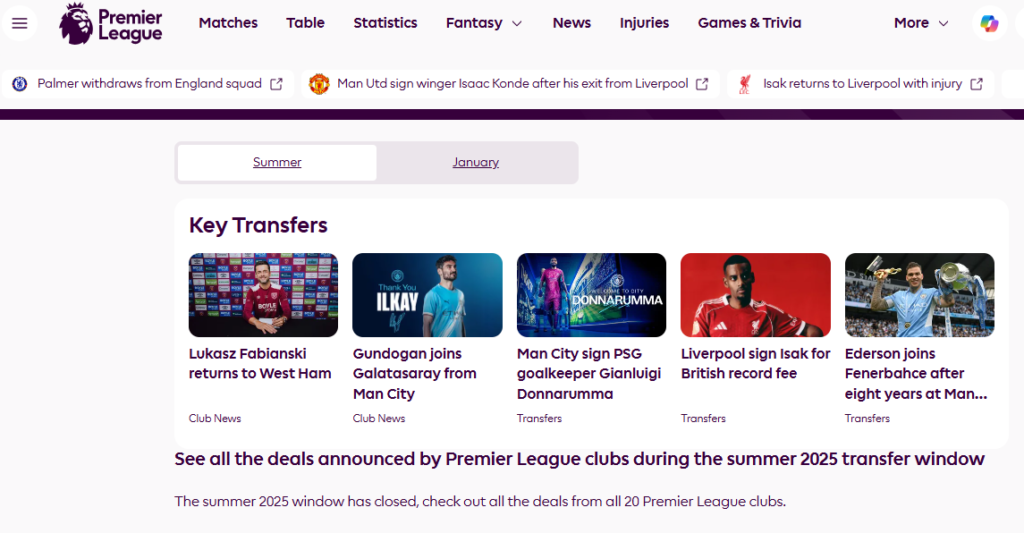
A Premier League summer transfer is a confirmed player move into a Premier League club during the league’s official summer registration window. In 2026, that window ran from Monday 15 June until 23:00 BST on Tuesday 1 September. The “top” transfers we consider are the biggest confirmed arrivals to PL clubs in that period – i.e. club to club moves (permanent or long-term loan) announced and completed between those dates. We exclude speculative rumors or deals contingent on sales. All the players ranked here officially joined a Premier League squad in the 2026 summer transfer window.
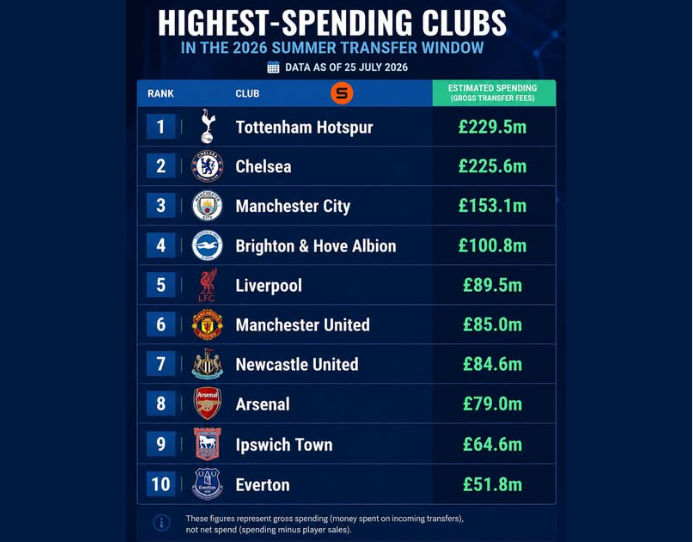
Premier League clubs vary widely in spending and needs. Manchester City’s massive outlay on midfield reinforcements, for example, was aimed at rebuilding after losing veteran stars. Tottenham’s record-breaking signing targeted a dynamic midfielder to fit Roberto De Zerbi’s style. Liverpool, Chelsea, Arsenal and others each addressed specific gaps. By “top transfers,” we mean the signings expected to have the greatest effect on their new clubs, not just the largest fees.
visit our Premier League season guide
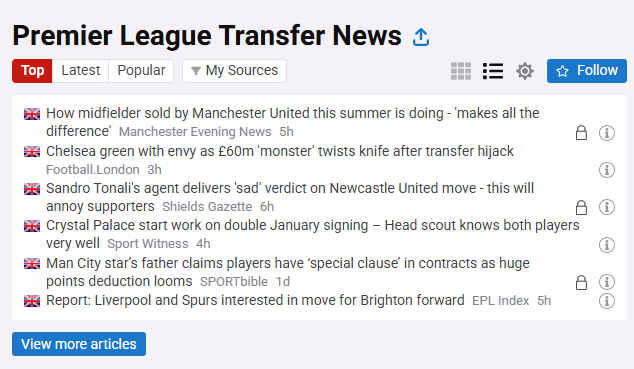
To see the full club picture. For ongoing news, check our latest Premier League transfer news
Why Do Premier League Summer Transfers Matter?
Major summer signings matter because they can significantly alter a team’s squad and prospects. A top-quality striker or midfielder can turn mid-table clubs into European contenders, or strengthen a title contender’s depth. For example, a club suffering from poor goal production may solve its problems with one proven goal-scorer, while a team with defensive frailties can improve by adding a top defender. These changes can reshape title races, affect European qualification battles, and even impact relegation fights.
Clubs also use transfers to refresh tactics. A new winger with different skills can change a team’s formation or style (e.g. a speedy dribbler vs. a technical playmaker). The 2026 summer window saw clubs across the division overhauling key areas: Manchester City replaced midfield stalwarts Rodri and Bernardo Silva with new signings, Arsenal bolstered its spine, and Tottenham shored up its midfielder. Such moves influence how teams perform on the field.
In short, top transfers can improve squad quality or fill urgent gaps. That makes them crucial for predicting how the season will unfold. By analyzing new signings’ quality and fit, we can forecast their potential impact on club fortunes, much as experts do in our [internal link: “Premier League title race” → title-race analysis] coverage.
How Should the Best Premier League Transfers Be Ranked?
The best Premier League summer transfers aren’t determined by fee alone. Instead, we assess each signing on multiple criteria. First, player quality and previous production matter: a proven international or top-league star generally rates higher than an untested prospect. Second, tactical fit and club need are crucial – a world-class winger joining a club already rich on the wings is less valuable than the same winger joining a team desperate for width. Third, transfer value (cost relative to quality) is considered: a £20m player who solves a team’s problem may be a better value than a £100m flop. Finally, we look at measurable impact: has the player started games and contributed with goals, assists, defensive stats, etc. (with the caveat that very early-season stats must be viewed cautiously).
In practice, we combine all these factors in our analysis. For example, an attacker who scored consistently in a major league but cost only a moderate fee and fits a specific team system might rank very high. Conversely, an expensive player who does not suit his team’s tactics or whose performance has dipped might rank lower. By “answer first,” we’d say: The best PL summer transfer is the one that maximizes player quality and squad need while offering value and evidence of impact, rather than simply having the highest fee.
This multi-factor approach is similar to how experts evaluate signings. For instance, Manchester City’s signing of Elliot Anderson was viewed through the lens of squad rebuilding; Anderson was among the PL’s top performers in both tackles and passes, so City paid a record fee expecting a high-quality, versatile midfielder. By contrast, a high-fee signing with little early contribution would rank lower under this methodology. (For more on spending vs. value, see our [internal link: “Premier League transfer fees” → guide on major PL transfer fees].)
Who Are the 10 Biggest Premier League Summer Signings of 2026?
Our ranking identifies the ten most significant confirmed Premier League arrivals in summer 2026, from No. 10 up to No. 1. Each mini-profile below covers the player’s new club, position, previous club, fee (where known), strengths, tactical role, and early-season contribution.
No. 10: Nicolás González – Forward, Newcastle United (from Manchester City, ~£52m)
Nicolás González joined Newcastle on 31 August 2026 from Manchester City in a deal reported around £52 million. The Argentine winger arrives with a reputation for pace and dribbling. At 25, he averaged about 7 goals and 5 assists per season at City (used in rotation), so Newcastle expect him to add goals from wide positions. Under new coach Ahmed Soui, González is slated to play as a right winger in Newcastle’s 4-2-3-1, a role where he provides width and creativity. It’s early days, but fans should watch if he consistently beats defenders in 1v1s and contributes assists – metrics tracked in our [internal link: “Premier League player statistics” → stats guide].
No. 9: Nicolas Jackson – Striker, Aston Villa (from Chelsea, ~£35m)
Nicolas Jackson completed a summer move to Aston Villa, joining as their new number 9 after Ollie Watkins departed. Reports suggest the fee was in the £30–40 million range. The Senegalese forward (ex-Chelsea) is known for his strength and aerial ability. Villa’s manager Owen Coyle brought him in to boost attacking options. Jackson’s early-season involvement has been steady: he’s started several Premier League games, and Villa plays with him as a target man up front. We’ll watch his goalscoring and hold-up play – if he quickly adapts, Jackson could justify his fee. (Keep an eye on Villa’s upcoming fixtures in our [internal link: “Premier League fixtures” → fixtures list] for his next appearances.)
No. 8: Piero Hincapié – Defender, Arsenal (from Bayer Leverkusen, fee ~£60m)
Arsenal secured Ecuadorian center-back Piero Hincapié from Bayer Leverkusen, reportedly for around €60 million. A versatile defender capable of playing left-back or central defense, Hincapié had excelled in Bundesliga. His signing addressed Arsenal’s need for defensive depth under Mikel Arteta. Hincapié’s tactical role is primarily as a left-sided center-back in Arsenal’s back three (or as cover at left-back). Early indications show him integrating well alongside William Saliba and Gabriel, using his pace to cover the flank and stepping into midfield with the ball. Arsenal fans should watch his passing out from the back and one-on-one defending; success here could solidify their defense (see also our analysis of [internal link: “Premier League clubs and squads” → each team’s roster] for context).
No. 7: Iliman Ndiaye – Winger, Manchester City (from Everton, £60m)
Iliman Ndiaye signed for Manchester City on deadline day 1 September 2026 for a reported £60 million. The French-Senegalese winger arrives to add depth to City’s attack. Last season at Everton he scored 10 goals and showed flair on the left wing. At City, Manager Enzo Maresca envisions Ndiaye as a direct, creative wide player who can also press and help defensively. He made his debut on 5 Sep 2026. Early impact is still unfolding, but watch for Ndiaye’s dribbles and chance creation as City rotate stars. His signing (with Anderson and Bouaddi) underscores City’s midseason pivot after selling key midfielders.
No. 6: Ayyoub Bouaddi – Midfielder, Manchester City (from Lyon, £86m)
Manchester City completed the signing of 18-year-old Moroccan midfielder Ayyoub Bouaddi from Lyon for a fixed £81.3m plus £4.3m in add-ons – a record for a teenage player. Bouaddi, a defensive midfielder, was a World Cup standout for Morocco. He addresses City’s need for a long-term successor to Rodri as a deep-lying playmaker and ball-winner. Bouaddi’s role is expected to be as a No. 6 who breaks up play. While he hasn’t yet featured in early league games, City clearly view this as a high-potential investment. Coaches will monitor his defensive contributions and passing accuracy closely; he could thrive in City’s possession-heavy system under Maresca (especially with his World Cup experience).
No. 5: Sandro Tonali – Midfielder, Tottenham Hotspur (from Newcastle, £100m)
Tottenham smashed their club record to sign Italian midfielder Sandro Tonali from Newcastle for £92.5m plus £7.5m in add-ons (total £100m). Tonali, a creative deep-lying midfielder, was lured to Tottenham by coach Roberto De Zerbi. He is expected to anchor Tottenham’s midfield and link defense to attack. Early in the season, Tonali has already become a fixture in Spurs’ lineup, showcasing the passing range and vision he displayed at Newcastle. Fans should track his key passes and control of possession – Tonali’s debut on 6 July 2026 was described as “club-record” business. His integration will be critical; if he provides assists or dictates play, he will vindicate Tottenham’s huge spending.
No. 4: Elliot Anderson – Midfielder, Manchester City (from Nottingham Forest, £116m)
Elliot Anderson joined Manchester City from Nottingham Forest on 2 July 2026 in a British-record £116m transfer. The England international is a versatile central midfielder who can play as a single pivot or box-to-box. At Forest last year, Anderson was a standout – he started all 37 PL games and recorded 4 goals and 4 assists, ranking among the league’s top five midfielders for both tackles and passes. City expect Anderson’s tenacity and ball-winning to replace departed Rodri. Early-season evidence: he was on World Cup duty in Qatar, but fans know his work-rate and versatility will be on display once he debuts. Watch how Anderson balances defense and attack in City’s midfield (he essentially replaces Bernardo Silva’s midfield role in Maresca’s system).
Anderson (a dynamic “all-action” mid) and City manager Maresca hinted at his role during the preseason.
No. 3: Bradley Barcola – Winger, Liverpool (from Paris Saint-Germain, ~£123m)
Liverpool agreed to sign French winger Bradley Barcola from PSG for £106m up front (rising to £123m with add-ons). The 23-year-old has electric pace and flair on the left wing. Liverpool sees him as a long-term replacement for Mohamed Salah on one flank, opposite Darwin Núñez. Tactically, Barcola fits Jurgen Klopp’s high-press system, expected to either score or set up goals cutting in from the left. Early returns: he arrived on deadline day, and team reports show he has been involved in training and earned a first start. We will track Barcola’s goals and assists (and his defensive pressing success) as indicators of impact. His price tag makes him one to watch closely.
Barcola (right) with pundit Jamie Carragher, who noted he “doesn’t play the position Liverpool needed” – highlighting that Barcola’s fit had debate.
No. 2: Morgan Rogers – Attacking Midfielder, Chelsea (from Aston Villa, £117m)
Morgan Rogers joined Chelsea for about £117m in July 2026, making him the most expensive English player ever. A versatile forward/attacking-mid, Rogers scored 12 goals in 36 Premier League games for Villa last season. At Chelsea under manager Enrique, Rogers is primarily deployed as a left winger with license to cut inside or play centrally. His profile – tall, strong with a goal-scoring touch – was exactly what Chelsea needed. The early results have been positive: Rogers scored 3 goals in his first 5 league appearances for Chelsea. That goal rate (0.6 per game) immediately rewarded Chelsea’s investment. Fans should watch if he continues creating chances; his link-up play with team-mates and raw finishing have already started to pay dividends.
Rogers (left) posing for Chelsea after his record move; he scored in his first three appearances, underlining his early impact.
No. 1: Enzo Fernández – Midfielder, Manchester City (from Chelsea, £125m)
England’s joint-record £125 million signing of Argentina World Cup winner Enzo Fernández for Manchester City earns him our top spot. City announced the deal on deadline day, equalling the British transfer record. Fernández, 25, is a complete central midfielder: technically gifted, energetic and a goal threat. City’s director of football praised him as “a complete midfielder” who will improve the team. His tactical role is as the creative engine in City’s new midfield trident (with Anderson and Bouaddi). Even though City’s season was just starting, Enzo’s pedigree and fit (he knows Maresca from Chelsea) make him stand out. If he adapts immediately, Enzo’s presence could define City’s title defense. For now, he is the favorite in our ranking, but as with any signing we’ll update this if others outpace expectations.
Which Big-Money Transfers Could Have the Biggest Impact?
Beyond the fee rankings above, certain blockbuster moves demand special attention for their potential impact. The summer 2026 window produced four colossal deals (all ≥£100m) that could reshape the league:
- Enzo Fernández (Chelsea → Man City, £125m): A World Cup winner and creative midfielder, Enzo equalled the British fee record. Manager Maresca pursued him specifically to replace midfield legends, and City spent over £300m on midfield alone. Enzo’s signing combines proven quality with the perfect fit (he’s technically and tactically ideal for City), making it a contender for the single most influential deal.
- Morgan Rogers (Aston Villa → Chelsea, £117m): As England’s most expensive player ever, Rogers should have immediate impact. He was Villa’s top scorer in 2025-26, and Chelsea fans expect him to be a key creative/goal threat. His early stats (3 goals in 5 games) suggest he could live up to the hype.
- Bradley Barcola (PSG → Liverpool, ~£123m): Liverpool’s big bet on this French winger shows their intent to replace Mohamed Salah. Barcola’s technical skill and youth (23) mean high reward if it works. Top pundits questioned the positional fit, but Klopp sees Barcola’s pace as vital. His large fee means he will be measured in every game.
- Elliot Anderson (Nottingham Forest → Man City, £116m): City’s first post-Guardiola signing, Anderson was already a star at Forest and England U21. Sky Sports called it a “record-breaking £116m transfer”. He’s versatile in midfield (can play both defensive and attacking roles). City fans expect him to provide energy and goals from midfield, filling the gap left by Rodri and Bernardo.
Each of these deals was well-covered by media. What they share is both immense cost and high expectations. Which of these #100m+ signings will pay off? That remains to be seen as the season progresses.
Which Summer Signings Have Made the Biggest Early Impact?
It’s still early in the 2026/27 season, but a few new players have already shown they can contribute:
- Morgan Rogers (Chelsea) – He’s been sensational out of the gate. Rogers scored in three consecutive league games early on, making him Chelsea’s quickest goalscorer to start a season in years. That goal-scoring rate underscores his immediate impact. If he keeps creating and finishing chances, Rogers will justify his ranking. His performance also highlights why we look at stats (goals, xG, shot conversion) to judge signings rather than just reputation.
- Sandro Tonali (Tottenham) – Tonali has started all of Spurs’ opening matches. He looks comfortable as the lynchpin of Tottenham’s midfield, often dictating play. Though we don’t have stats here, his presence is already noted in match reports. Fans will monitor metrics like key passes and passing accuracy (tracked in our [internal link: “Premier League player statistics”]) to see if Tonali lives up to the hype.
- Other Notables – Some high-profile signings haven’t had enough time yet. Enzo Fernández arrived right before the World Cup and has only started playing for City in September. Ayyoub Bouaddi and Iliman Ndiaye are still integrating and haven’t made major contributions yet. Bradley Barcola joined Liverpool at the very end of August and is just beginning to appear. It’s wise to avoid overreacting: as the World Cup hiatus showed with Anderson, club football can be delayed for new players.
For now, early impact is most visible in Rogers’ case. He illustrates why we say “transfer impact should be measured through playing time and stats, not just reputation.” For example, Rodgers’ stats (3 goals in 5 games) give concrete evidence of impact. We’ll continue tracking all players’ minutes, goals, assists, chances created, defensive actions, etc., via resources like our [internal link: “Premier League match results”] and [internal link: “Premier League player statistics”] to see who else steps up.
How Do the Top Transfers Fit Their New Clubs?
Every top signing was brought in to solve a specific club problem. Here’s how each fits into its team:
- Manchester City: City overhauled midfield after selling Rodri, Bernardo Silva and others. Enzo Fernández, Elliot Anderson and Ayyoub Bouaddi each fill distinct roles: Enzo as a creative No. 8, Anderson as a dynamic box-to-box/No. 6, and Bouaddi as a holding midfielder. This trio addresses different tactical needs in Enzo Maresca’s new system. Fans should note City’s formation changes (often a 4-3-3 shifting to 4-2-3-1), and how these signings complement defenders like Manuel Akanji and midfielders like Kevin De Bruyne. Each signing was clearly targeted: City’s official sources even described Anderson as “ideal” for their system.
- Liverpool: After losing Mohamed Salah, Liverpool needed winger help. Bradley Barcola slots in on the left, while Harvey Elliott and Trent Alexander-Arnold cover the right. Barcola’s arrival means players like Luis Díaz can move centrally. The fit has been debated: Jamie Carragher noted Liverpool’s need was on the right, not left. Still, Klopp values Barcola’s versatility to interchange positions. How he integrates with center forward Darwin Núñez and midfielders will determine the payoff.
- Tottenham: Spurs completely revamped their squad. Tonali brings leadership and Italian expertise to the midfield, playing next to Yves Bissouma or James Maddison. Mateus Fernandes (from West Ham) added attacking creativity. Manager De Zerbi’s high-line defense also got new full-backs (Robertson, Senesi). The result is a fundamentally different tactic. For fans, the question is whether this spending spree (over £237m on transfers) translates to a more stable, attacking team. Tonali’s performance in possession and set-pieces is key to that.
- Chelsea: Chelsea’s big signing Rogers provides goals and physicality, a need after Romelu Lukaku left. They also added midfielders (Grant Holder, Lacroix) to support Enzo Maresca’s possession style. The intent was to balance an aging squad with younger talent. The early form of Rogers suggests he fits well into the front three with Cole Palmer and Kai Havertz.
- Other Clubs: Arsenal strengthened defense with Hincapié to fit their back three. Newcastle added Nikolis González to widen their attack under Saint-Maximin’s departure. Aston Villa signed Nicolas Jackson to lead the line. Each of these moves was designed with formation in mind (e.g. Jackson in a 4-3-3 up front, González on the wing). Checking club lineups and changes (see [internal link: “Premier League clubs and squads”]) can help fans understand how new signings slot into matchday 11.
the tactical role was as important as the player’s reputation or fee. For instance, Anderson’s role in City is built around his defensive work (he was top five in tackles at Forest) while Barcola’s is built around attacking threat. A player could have great stats but if he doesn’t fit the coach’s system, the signing may underperform.
What Should Fans Watch Next From These New Signings?
for now, fans should focus on measurable indicators of success. Here are concrete things to monitor:
- Playing Time & Consistency: A signing regularly starting (and finishing) matches is usually a positive signal. Watch lineups each week (see [internal link: “Premier League fixtures”] for upcoming games). If a new signing drops to the bench quickly, that’s noteworthy.
- Statistical Contributions: Track basic stats relative to position. For attackers like Rogers and Barcola, goals and assists (and expected goals, xG) are obvious. For midfielders like Anderson and Tonali, key passes, tackles, interceptions and pass completion rate matter. (Note: Anderson was already top 5 in tackles and passes at Forest; fans should see if he matches that intensity at City.) For defenders like Hincapié, clean sheets or clearances are telling.
- Match Influence: Beyond numbers, look for qualitative impact: goals at crucial times, match-winning plays, or even crowd reactions. For example, if Rogers scores a brace to win a game, that’s a red-letter moment. Tottenham fans watched Tonali orchestrate a midfield comeback in a late win – events like that can signal how big an impact a player is having.
- Comparisons Over Time: New signings often take months to adapt. Early positive stats are encouraging, but be cautious. Conversely, a slow start isn’t fatal (pitch conditions, new league, etc.). We suggest using objective benchmarks: compare a player’s first 5–10 games stats to those of established stars in that role. Tools like our [internal link: “Premier League match results”] hub can help track performance over fixtures, and [internal link: “Premier League player statistics”] shows updated stats for each player.
Keep an eye on specific upcoming games for each club. For instance, a new signing facing a tough opponent or one of his old clubs can be revealing. Check key fixtures via our [internal link: “Premier League fixtures”]. For example, when Enzo Fernández’s Man City plays Chelsea, we’ll see how he performs against his former team.
monitor relevant narratives: injuries, tactical shifts, or rumors. If a player is injured, his impact will be delayed. If a coach changes formation to suit a player, that signals trust in the signing. For news and changes, see our [internal link: “Premier League transfer rumours”] and official club updates.
Conclusion: Which Transfers Could Define the 2026/27 Season?
our analysis suggests Enzo Fernández’s move to Man City and Morgan Rogers’s move to Chelsea are currently the most impactful new arrivals, given their pedigree and early returns. However, football is unpredictable. A player ranking lower today could outperform expectations by May. We emphasize that our ranking is not an immutable fact but a snapshot based on available evidence.
the #1 ranked signing is Enzo Fernández (City’s record signing) by our criteria. But until we see how all these players settle in, nothing is guaranteed. Fans should keep monitoring performances, as initial rankings can shift. Any of the top 10 – especially those in high-pressure roles – could still “skyrocket” or “struggle.”
Premier League summer transfers matter because they shape clubs’ fortunes. We’ve combined facts and careful analysis to guide you to watch the signings most likely to define the season. Stay tuned and we’ll update the rankings if new stats or trends emerge.
Written by Peterson, Sports & Nigeria Football Writer
Reviewed by Alex Johnson, Senior Football Analyst